
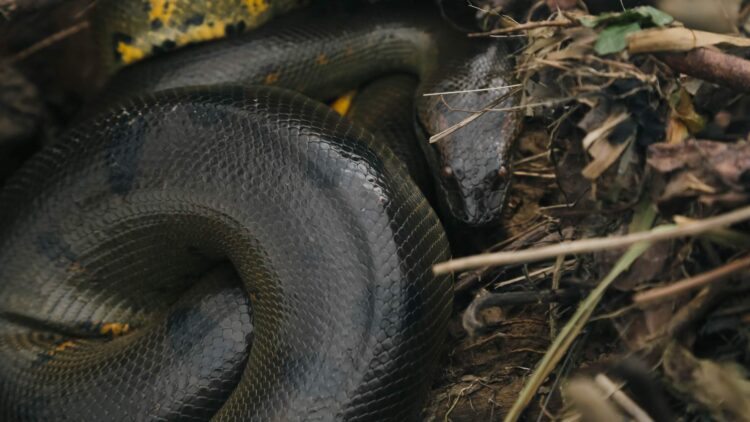
Snakes come in all shapes and sizes and some of them can achieve quite the impressive length. The biggest snake that we have today is the Green Anaconda, which is a quite large specimen, but if we want to know which snake is the biggest in the world we have to go back a few millenia in order to find the Titanoboa cerrejonensis, a now-extinct serpent.
Discovered in a Colombian coal mine called Cerrejón back in 2009, this snake’s fossil left scientists absolutely stunned, as it measured up to 42 feet likely weighed over a ton. It might have needed to be that big in order to survive the world back then, as dating the fossil revealed that it lived roughly 58 to 60 million years ago.
The Titanoboa cerrejonensis snake, a scary marvel of nature
Since there are plenty of snakes nowadays that have characteristics similar to this one, it was not hard for scientists to liken it to a boa. This means that unlike using venom like cobras or vipers, these prehistoric snakes killed their prey by squeezing. Just like modern boas, they wrapped around their prey and waited, every time the prey exhaled, the snake tightened its grip just a bit more, cutting off air supply until there was no more movement. Then, the snake would unhinge their jaws and slowly swallow the animal whole, taking its time to digest the prey once it was inside their body.
Since this is quite common nowadays, it did not surprise scientists to discover how the Titanoboa cerrejonensis killed. What surprised them is the type of prey it chose. As snakes are cold-blooded, they cannot regulate their internal temperature like warm-blooded mammals, which is why they prefer sunny environments that are warm, like the middle of a road with no vegetation close. This is what gives them the warmth that they need to survive, as otherwise they hibernate to keep their bodily functions down. If we extrapolate this, we can infer that a snake as big as the Titanoboa needed a consistently warm environment just to function, which scientists were able to calculate to between 86 and 93°F just to keep its metabolism going.
Luckily, that was the average temperature of the Paleocene period, which is when it was alive. This time period was a lot warmer, especially in the tropics, thanks to all the extra carbon dioxide in the atmosphere. Another thing about snakes, especially anacondas and other types of boas, is that they really enjoy water, which could also have been true for the Titanoboa cerrejonensis. This is because water offers both support and easy access to prey, in this case, and unlike their modern counterparts, the Titanoboa hunted and ate mainly fish.
This was discovered in later trips to the mine where the fossil was found, as there were plenty of skull fragments, including parts of the jaw, braincase, and palate, which allowed researchers to create new models of the head. They then found that the updated skull length came in at about 16 inches, and that meant Titanoboa may have actually grown up to 47 feet long, five more than originally thought, and that the teeth were loosely attached.
This would have been strange if it ate the same kind of mammals that current iterations of this snake, but if it ate fish it would make sense, as even some nowadays that follow this diet have looser teeth. While this might seem like an anticlimactic discovery, after all it is not the expected nightmare fuel of a dinosaur eating monster, it does explain a lot about the Earth at that time and helps us better understand and demystify the past.