
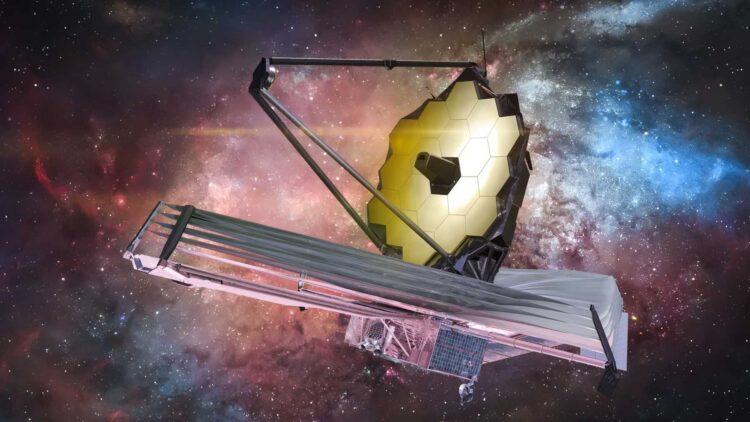
Since space is so vast and the Milky Way still has many undiscovered secrets it can be very tempting to limit our exploration to celestial objects that are close to home, but scientists have long ago realized that the best way to understand the universe around us is to try to gather as much data as possible, and for that, they need to look far and wide. The James Webb Space Telescope is one of the best weapons that they have to do this, as thanks to it we have been able to discover many planets, amongst which we find a curious oddity, a frozen planet that was unexpected.
The planet in question is located about 60 light-years from Earth and it orbits a star called 14 Herculis, a sun-like star located between Vega and Arcturus in the Hercules constellation. While most exoplanets are though to be hot, 800 °C and up, the planet that orbits 14 Herculis is not, in fact, quite the opposite. It is actually cold, about –3 °C (26°F) and reminds scientists of Jupiter, even though it is about seven times its size.
The fact that The James Webb Space Telescope was able to pick up its signal is also nothing short of amazing, especially considering that its camera works on infrared, which captures heat a lot better than cold. However, in a surprising turn of events, the gold-coated 6.5-meter mirror and infrared camera (NIRCam), managed to pick up the planet’s faint heat signature despite the low temperature.
Why 14 Herculis is so interesting and what we can learn thanks to The James Webb Space Telescope
Well, the 14 Herculis star has more than one exoplanet, which for those unaware, are just planets that orbits a star other than our Sun. The one that is comparable to Jupiter has been named 14 Herculis c, to continue the nomenclature of the system, and it is accompanied by another exoplanet that we know almost nothing about because it is behind a blacked-out spot created by a coronagraph, a tool The James Webb Space Telescope uses to block out blinding starlight so it can see the dimmer celestial bodies nearby.
The thing with these two planets is that they are not on the same orbital plane and that is highly unusual. Instead of orbiting normally around their star, they are tilted in relation to each other and since we do not have enough information to know what this is, scientists have ventured a few theories. The most popular one is that there used to be a third planet that balanced them out, but it got left behind or just out of the solar system early in the system’s life. While we cannot confirm this theory, the more information that we gather the better prepared we will be in the future when we continue to find other planets.
But the finding of 14 Herculis c is still an amazing feat that has enormous repercussions even if we do not understand its solar system. Since capturing an image of a cold exoplanet is almost impossible, the fact that The James Webb Space Telescope can do it opens up a world of possibilities for the thousands or even millions of other celestial bodies that are around us that we could calibrate it to see.
Kowing that it can be done will allow Astronomers to be able to find older planets that are colder and that have never been seen before. This could also mean a chance to discover a planet that has the right ingredients to form life, which is something that still has not happened despite scientists’ best efforts.