
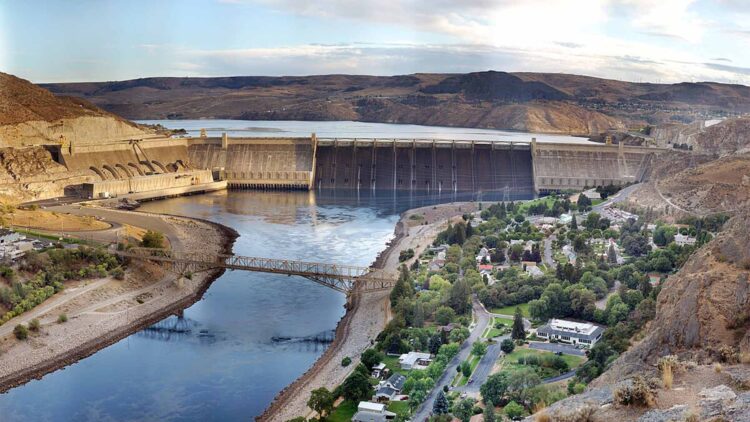
By regulating the Columbia River in the northwest of the United States, the Grand Coulee Dam became an engineering landmark and a source of irrigation and power. A reservoir so big that it redrew the map of Washington, Lake Roosevelt.
Its turbines started to spin in 1942, and also powered World War II manufacturing, including the Manhattan Project, by providing energy.
Being one of the biggest hydropower projects worldwide, it continues to be a distinguishing symbol of renewable energy, clean energy, and engineering.
The canals that branched off of Lake Roosevelt brought an agricultural era, transforming dehydrated territory into green fields with used irrigation. However, the dam also destroyed historic fishing grounds and traditions stopping salmon migrations that were vital to Indigenous peoples for centuries. In contrast to China’s Three Gorges Dam, the Grand Coulee is now somehow a victory and a lesson.
Power, irrigation, and the war effort
It was unthinkable in the 1930s to build a concrete wall that was a mile long and more than 500 feet high. However, many people in the Pacific Northwest experienced unemployment, darkness, and barren land during the Great Depression. The solution was to construct the Grand Coulee Dam, which was larger than anyone could have ever envisioned.
Lake Roosevelt, which was 151 miles upstream when it filled, contained trillions of gallons of water, the raw energy that would drive a new era. The Columbia River flows through steel penstocks bigger than subway tunnels inside the dam, crashing against turbines “the size of houses.” It generates over 6,800 megawatts of power from its 24 generators. During World War II, that energy drove the manufacture of airplanes, lit up cities throughout the Northwest, and powered aluminum factories. Even the Manhattan Project used its rotating turbines to generate electricity.
While this was going on, over half a million acres of dry land were turned into agriculture by the irrigation system that branched off of Lake Roosevelt. Once it started to support crops like wheat, apples, and potatoes, which are today essential to Washington’s economy.
What a megadam creates and destroys
The Grand Coulee Dam served as a metaphor for how engineering may use nature to advance humankind. It showed how a powerful river can be managed by a single structure.
But there was a price for that control. The traditional salmon rivers that provided help to the Indigenous peoples for centuries were cut off by the dam. Underwater, sacred fishing spots disappeared. The United States lost its culture, ecosystem, and ancestral balance in exchange for its improvements in irrigation, hydropower, and clean energy.
The dam is still necessary, though. Its fills the void that solar or wind power outages leaves with renewable energy preserving stability in the grid. The agriculture around the region is still fueled by its reservoir.
Why Grand Coulee still matters
The Grand Coulee Dam still hums in the center of Washington and the US almost a century later. However, its narrative also teaches that every step forward creates shadows. Pursuing clean energy and renewable energy has to take into consideration the ecosystems and cultures that give a river life, as shown by the obstructed salmon rivers and the disrupted livelihoods of Indigenous peoples.
The lessons learned from Grand Coulee are more important than its size or power output when compared to China’s Three Gorges Dam.
The dam continues to be a daring accomplishment and a call for balance: the next big project should be evaluated not just by megawatts and acres of land that is irrigated, but also by the protection of cultures, the flow of rivers, and the balance between development and land preservation.