
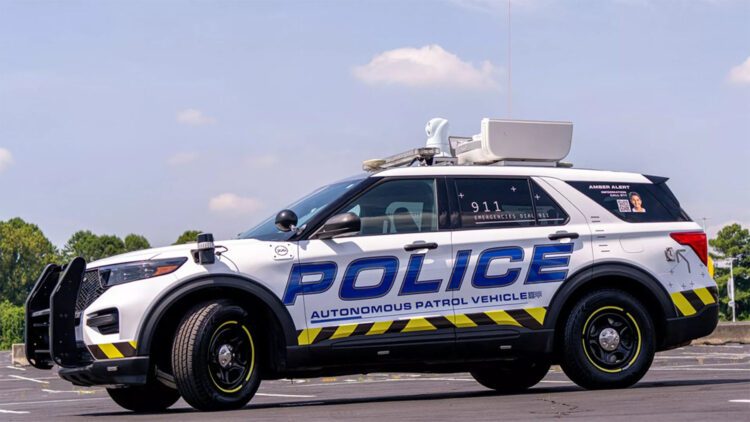
PUG (Police Unmanned Ground), the nation’s first autonomous police cruiser, was unveiled by the Miami-Dade Sheriff’s Office. Although it looks like a Ford Explorer, it is an autonomous car made to assist law enforcement, not to stop or issue tickets. Sheriff Rosie Cordero-Stutz described the addition of secure, technologically advanced “touchpoints” for the community as “an important key piece.”
According to the Miami Herald, PUG, which was created by the nonprofit organization The Policing Lab, was displayed at Super Cars Room Miami and donated to the organization without using public funds.
According to the nonprofit, future cars made for other departments could cost between $150,000 and $200,000. In order to get feedback, the car will be on display at community events through October. Later this year, it will start doing limited patrols.
Consider PUG to be a mobile tech hub with an integrated police drone, a rolling information post, and a visible deterrent—a support unit that going beyond the capacity of human officers.
What PUG is and what it does
PUG is fundamentally a patrol partner. It is an autonomous car that will mostly drive along predetermined routes, show messages to the public on its windows, and be visible in “hotspot” areas where regular patrols could discourage crime.
Sheriff Rosie Cordero-Stutz provided a useful example: PUG could sit inside a hurricane evacuation area and show real-time updates “on a banner telling citizens what’s going on.” Deputies can use PUG to access additional tools, like a mobile police drone, thermal imaging, 360-degree cameras, license plate readers, audio sensors, and touch-screen windows, in addition to messaging.
Knowing what PUG won’t do is important too, of course. It cannot be used in pursuits, has a speed limit, and cannot travel on highways. It won’t issue tickets and isn’t designed to be a “robot cop.” Information, presence, and safety are the main objectives—not a deputy replacement.
For at least the first year, a deputy will sit in the front seat while the vehicle operates on its own while the Miami-Dade Sheriff‘s Office gathers community input and adjusts PUG’s usage. It won’t be allowed to roll unattended on Miami-Dade streets until “a healthy amount of community feedback,” according to Cordero-Stutz.
Who built it, what it represents and the role of people coming together involvement
The nonprofit organization The Policing Lab, which has been working on the design for years, is the origin of PUG. This first unit was donated by the organization, according to the Miami Herald. But the price range for additional PUGs built for other agencies will be between $150,000 and $200,000 per vehicle.
It features 360-degree cameras to minimize blind spots, thermal imaging for low-light or nighttime conditions, license-plate readers to help in investigations, audio sensors, touch-screen windows for instant “PSA”-style messaging, and a police drone that is prepared to flight for an overhead view.
The agency wants to “get it out to as many communities” as possible, according to Sheriff Rosie Cordero-Stutz, in order to hear concerns, respond to questions, and improve the product. For this reason, the roll-out begins at community events, allowing locals to get a close-up look at PUG, learn what it can and cannot do, and provide input on where it is most helpful.
A careful approach to law enforcement in the future
This is a test for Miami-Dade to see how an autonomous car can improve police. Limits are made clear by the Miami-Dade Sheriff’s Office:
PUG is not a replacement for human deputies, a chase vehicle, or a ticket writer. When seconds count, this tool can roll through “hotspots” as a visible presence, park in an evacuation zone with alerts, and deliver a police drone and additional eyes to a crime scene.