
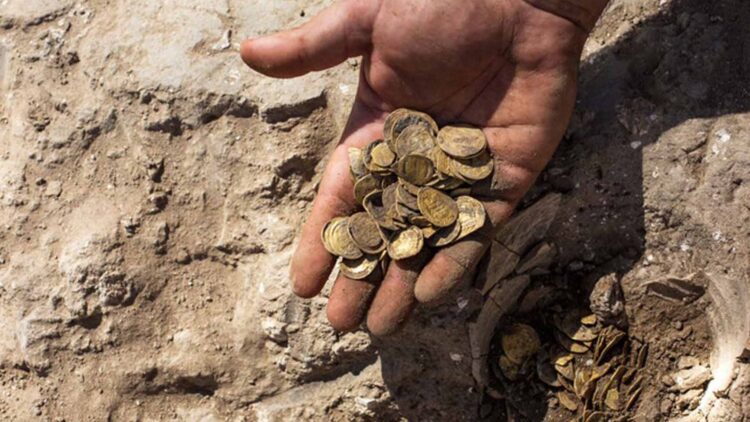
Hundreds of Celtic gold and silver coins, jewelry, brooches, and even a little bronze horse sculpture have been discovered by a team of Czech archaeologists in the peaceful Western Bohemian countryside, close to Pilsen. The fact that this discovery was made in a region where no Celtic settlement had ever been documented makes it remarkable.
The Museum and Gallery of Northern Pilsen in Mariánská Týnice, in association with the Czech Academy of Sciences’ Institute of Archaeology, reported the discovery.
To keep the site safe, the dig, which started in 2021, has been kept under secret. Giving a unique insight into life throughout the Iron Age and the La Tène period, experts describe the discovery as “exceptional, at least within the Central European context.”
A hidden Celtic marketplace
Some of the objects are smaller than a fingernail and belong to the era from the early Iron Age to the La Tène period and date from the sixth to the first century BC. No evidence of permanent residences or fortifications was discovered by archaeologists, and this makes it interesting; according to this, the location was probably a seasonal marketplace where Celtic tribes gathered to exchange products rather than a settlement.
“It could have been a seasonal site where people accidentally lost small objects like coins,” explained David Daněček, archaeologist at the Institute of Archaeology of the Czech Academy of Sciences.
They found a surprising amount of coins, many of which have unidentified designs and are still unidentifiable. Daniel Stráník of the Museum and Gallery of Northern Pilsen stated, “Among the gold and silver coins, we have found previously unknown types that could change our understanding of Celtic coinage in Bohemia,”
Archaeologists also discovered pendants, bracelet fragments, fibulae, cut gold and silver bars, and a little bronze horse that might have served a decorative or religious purpose.
Greek influence reaching north
The creative design of the coins is among the most intriguing elements. Several pieces exhibit definite Hellenistic influences, including stylized human faces, suns, and horse themes reminiscent of Macedonian and Thracian art. This implies that rather than being isolated, Celtic communities in Central Europe were linked to the ancient Greek world through trade and culture.
“Many of the small coins show portraits inspired by Hellenistic designs from Macedonia and Thrace,” confirmed Pavel Kodera, director of the Museum and Gallery of Northern Pilsen. “This points to strong cultural contact between the Celts and the Greek colonies near the Adriatic and the Balkans.”
To find out more, scientists are analyzing the gold’s isotopic composition to see whether it was imported or came from nearby mines. If verified, this would demonstrate that Western Bohemia was part of a much larger trading network that connected the Mediterranean and Central Europe.
While the most expensive items are kept in safe storage until the scientific investigation is finished, a portion of the treasure is already on exhibit at Mariánská Týnice. “The real value of this discovery lies in how well preserved and undisturbed the site is — something rare in European archaeology,” said Jan Mařík, director of the Institute of Archaeology of the Czech Academy of Sciences.
A silent window into Celtic life
There is no indication of walls, houses, or cemeteries at the location, and it does not correspond with known Celtic strongholds in Western Bohemia. But the location at the intersection of rivers, woodlands, and fertile plains would have made it perfect for ceremonial meetings or trade.
The irregularly cut gold and silver bars suggest barter rather than a formal monetary economy. As David Daněček explained, “These could have been used in exchange, or possibly minted under the approval of a regional ruler.” Painting a broader picture of Celtic culture.