
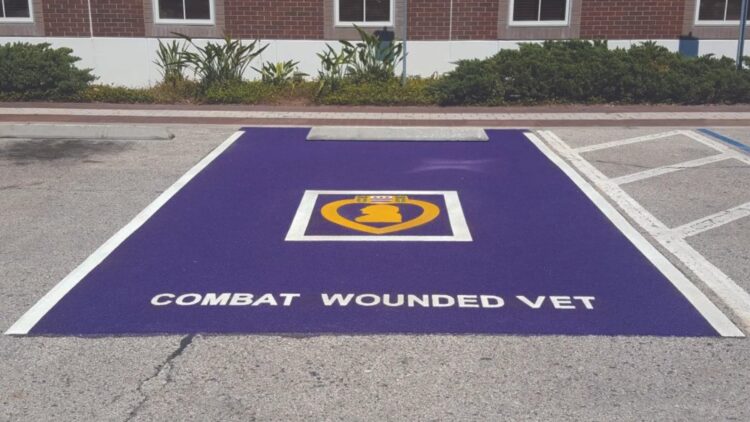
You have surely noticed that purple parking spaces are now found in nearly every state in the nation, after the first one appeared in Ohio in 2015, according to information published by Reader’s Digest. But do you really know what they are for? They are called Purple Heart parking spaces and are reserved for wounded veterans in the United States.
According to Purple Heart recipient Brian Thomas, who served with the 1st Infantry Division in Operation Iraqi Freedom, it is a label that removes stigma about the physical abilities of veterans, which might be the case with blue spaces for the disabled. Thomas says it also serves as a tool to empower the sense of pride in veterans, which helps with emotional scars. There is no national law regulating them, so it is up to local and state ordinances to take action.
Purple Heart parking spaces
It is very possible that you have noticed that over time, purple parking spaces, known as Purple Heart parking spaces, have started appearing in your area. According to information published by Reader’s Digest, the first one appeared in 2015 in Warren, Ohio, and eventually spread across virtually the entire country. Do you really know what they are for and who they are intended for? Purple Heart parking spaces are reserved for wounded U.S. veterans who, although they can also use blue spaces for the disabled, carry a different symbolic significance.
According to Purple Heart recipient Brian Thomas, who served with the 1st Infantry Division in Operation Iraqi Freedom, blue spaces carry a certain stigma regarding the physical abilities of veterans, which is absent with Purple Heart spaces. In his statement to Reader’s Digest, he said, “These types of points not only relieve the guilt associated with disabled parking spaces, or the signage and perceived judgment around them, but they often empower a sense of pride.” He also added that these kinds of spaces “arouse curiosity, awareness, or even a little conversation” about the constant duality that veterans face.
What happens if someone parks in them?
In principle, there is no national law regulating Purple Heart parking spaces, unlike parking spaces for disabled people. These are regulated by state and local ordinances, so the rules vary. While in some states it is necessary to carry identification to park in them, in others it is not. The same goes for penalties: some states impose fines or require community service, while in others the offender is only reprimanded.
Frequently asked questions
When the first Purple Heart parking spot appeared?
In 1015, in Warren, Ohio.
How does it differ from the blue blue handicap spaces?
According to Brian Thomas, Purple Heart recipient who served with the 1st Infantry Division in Operation Iraqi Freedom, ““These sorts of spots not only alleviate the guilt associated with handicapped spaces, or the signaling and perceived judgment around those, but often empower a sense of pride”.