
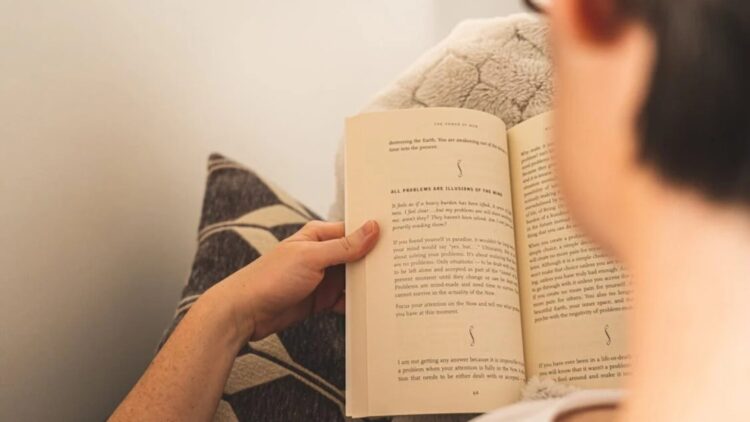
Are you the type of person who reads books starting from the beginning and going in order to the end, or the type who prefers to read the ending of the story before reading the book itself? If you belong to the second group, this behavior has been defined by psychology.
Two researchers at the University of California, San Diego, Jonathan Leavitt and Nicholas Christenfeld, have studied this phenomenon and concluded that this type of behavior is linked to specific personality traits, related to the need for predictability or control, a low need for cognition, or a high processing fluency ability. Knowing how a story will end is, for some, a relief that allows them to enjoy other aspects of literature without worrying about what will happen next in the story.
Reading the end of a book first
Although for some it may be an inconceivable gesture, there are many people who read the ending of a book before reading the book itself. What’s the point of this? What sense does it make to then read the development of the plot? Why do they do it? Psychology has provided an answer to this behavior, and although it may seem nonsensical, it has its reason for being. Two researchers from the University of California, San Diego conducted a series of experiments to determine the motivation for reading the endings of books first. They are Jonathan Leavitt and Nicholas Christenfeld, whose study consisted of experiments using 12 short stories of all genres: twists, mysteries, literary pieces, ironic pieces, etc.
The research was conducted as follows: each participant read three versions of a story, an original intact and spoiler-free version, one preceded by a paragraph that spoiled the ending, and a version in which the spoiler information was integrated into the story. The results revealed that readers rated the spoiler versions as more enjoyable. How is this possible? Leavitt and Christenfeld stated that when the reader knows the ending of the story, it makes it easier to process cognitively. If you already know what is going to happen, you don’t have to invest part of your attention in thinking “what happens next,” but instead focus on other aspects of reading, such as the language, themes, or plot mechanics.
Personality traits
Even knowing the ending does not mean that the rest of the surprises in a story are uninteresting to the reader. However, the comfort and clarity provided by the predictability of the ending allow them to enjoy the story more. According to researchers and Psychology, more mental resources are freed up to focus on the tension in the story’s structure and emotional depth. These results have been linked to various personality traits that could be associated with this type of behavior:
- Low need for cognition. Subsequent studies have linked a reduction in mental effort and an easier ability to follow the plot in those individuals who prefer a spoiler rather than delving into a deep and mentally demanding storyline.
- Need for predictability and control. Uncertainty, in not knowing, is often accompanied by anxiety, so knowing how a story ends can reduce it and give the reader a sense of logic.
- High processing fluency. The study determines that when the brain already knows the outcome, reading becomes much more fluid and enjoyable for the reader, as they can process information such as clues, narratives, and story figurations with greater understanding and ease.