
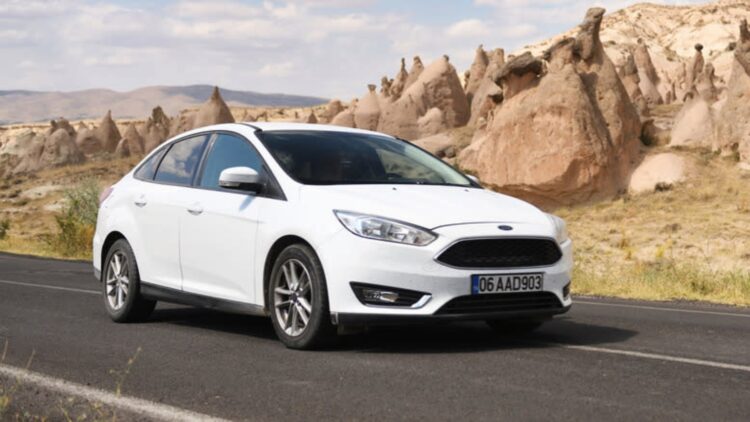
After 27 years of history and more than 12 million units sold, Ford has had to say a definitive goodbye to its Focus, a global model born under the Ford 2000 initiative that marked several generations. Its disappearance, which began in the United States in 2018 and now reaches Europe as a result of the push towards electrification, leaves a critical gap in the industry and in the identity of the ‘Blue Oval’ (Ford).
Although sporty variants like the ST and the legendary RS—with AWD and the backing of figures like Ken Block—brought prestige to the brand, the current craze for SUVs and crossovers like the Puma and the Kuga has not managed to compensate for the market loss. With the elimination of the Fiesta and the Focus, Ford has fallen from 2nd to 12th place in sales in Europe, leaving the Mustang as its only traditional ‘car’ and facing an uncertain future where, according to Bill Ford Jr., the company’s lineup is no longer as robust as it should be.
Ford legacy
The Ford Focus was not just another car; it was the cornerstone of an ambitious globalization strategy. It was first launched in 1998 with the mission of replacing the veteran Escort and unifying the markets of Europe and America under a single design and quality standard. It not only succeeded, but for nearly three decades it became the quintessential family car, offering not only an affordable price but also driving dynamics that surpassed those of its direct competitors.
It is worth noting that the success of the Focus was not limited to the mass sales of its standard versions, but also in that it managed to become a cult model. In 2002, the ST170 appeared, but it truly reached its peak with the Focus RS. With its turbocharged engine, all-wheel drive (AWD) system, and aggressive styling, the RS500 became a model capable of delivering rally sensations on open roads. The support of icons like the late Ken Block elevated the Focus from being just a means of transportation to a symbol of performance and fun.
The crisis of compact cars vs. SUVs
Despite this track record of success, the automotive market has changed completely, no longer demanding compact models like the Ford. The rise of SUVs and crossovers has captured sales from traditional sedans and hatchbacks, and in Ford’s strategy to adapt, it has had to leave behind some models like the Focus to focus not only on other models but also on their electrification.
The strategy, however, has shown worrying cracks. By eliminating the Fiesta and the Focus, Ford has left millions of customers looking for compact and affordable vehicles without options. Models like the Puma and the Kuga have tried to fill that space, but the figures from the European Automobile Manufacturers Association (ACEA) are relentless: Ford’s market share has plummeted.
What awaits Ford?
Although there are rumors about a possible return of the name in an electric format, there are no concrete plans suggesting that we will see a new compact hatchback anytime soon. For now, the Mustang remains the last representative of Ford’s passenger cars. The industry watches as a brand that once dominated the market tries to reinvent itself. While we wait to see if the company manages to recover, all that remains is to say goodbye to a vehicle that, for 27 years, proved that a functional car could also become a symbol.
Frequently asked questions
Why is the Ford Focus disappearing?
Because of the rise of SUVs and crossovers and the brand’s strategic shift toward electrification.
What impact has its departure had on sales?
Ford has dropped from 2nd to 12th place in Europe after losing key models like the Focus and the Fiesta.
What is the only traditional car Ford still has?
After eliminating its compact cars, the Mustang is the only non-SUV passenger model remaining in its lineup.