
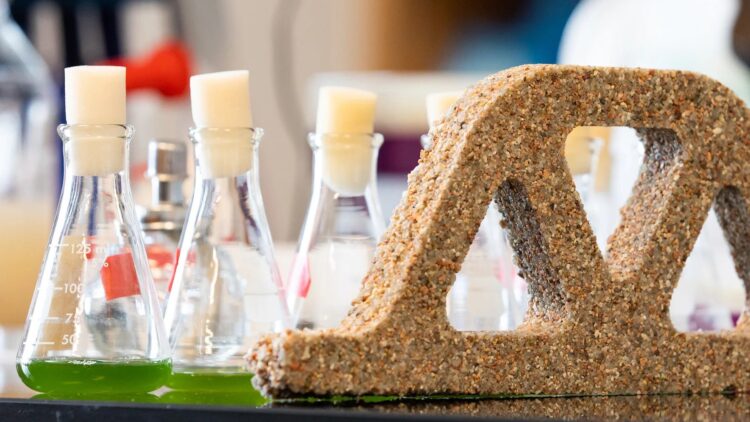
Based on research carried out by Montana State University and published in the journal Cell Reports Physical Science, the construction industry is moving toward a sustainable revolution through the development of living materials in the engineering sector. This new material fuses the mycelium of the fungus Neurospora crassa with the bacterium Sporosarcina pasteurii, and has the ability to create lightweight, bone-like structures that can remain biologically active for at least a month.
According to the team led by engineer Chelsea Heveran and lead author Ethan Viles, this breakthrough not only promises to reduce 7% or 8% of the global CO2 emissions generated by the cement industry, but also offers a solution to the problem of the 600 million tons of debris generated by demolition in the United States.
A living brick
The team from Montana State University, led by Ethan Viles and Chelsea Heveran, has managed to cultivate a material capable of turning chemicals into stone. The study was conducted in April 2025 and was published in the journal Cell Reports Physical Science. The process of creating this material has nothing to do with what has been seen so far in traditional heavy construction methods. Instead of subjecting minerals to extreme temperatures in industrial furnaces, the researchers opted to grow the material.
First, they use the mycelium of the fungus Neurospora crassa (commonly known as red bread mold) to fill molds with dense filament networks, creating a porous and spongy base. Then, it is immersed in a solution of urea and calcium along with the bacterium Sporosarcina pasteurii. This microorganism has the primary mission of breaking down urea to generate calcium carbonate, the same mineral that hardens seashells. This process results in a block cemented by mineral crystals that preserves life within it. According to the study, “Both the fungus and the bacteria remained alive inside the mineralized blocks for at least four weeks”.
An ally against the climate crisis
The urgency of this technology originates from the environmental impact caused by conventional concrete. Cement production is one of the hardest activities to decarbonize. According to the Environmental Protection Agency (EPA), construction waste in 2018 outweighed the total U.S. household trash by double, not counting the massive waste it generates. This new discovery brings another possibility to the table: a circular economy where it is possible to grow at low temperatures near construction sites, while at the same time being capable of regenerating to repair damage, and being fully recyclable at the end of its life cycle.
Will it be used in home constructions?
Although it is still not possible to build mycelium skyscrapers —since it cannot withstand the effects of extreme climates nor has sufficient strength— the short-term applications are promising. Projects like Fungateria in Europe are already exploring walls that can “feel” their environment and adapt. Experts predict that these innovations will first appear in specific uses and, over time, these blocks could “heal” microcracks on their own, extending the lifespan of our homes.
Frequently asked questions
How are these living bricks made?
A network of fungi (Neurospora crassa) is cultivated, and bacteria (Sporosarcina pasteurii) are added that transform urea and calcium into stone, creating a bone-like material that stays alive for a month.
What positive impact do they have on the environment?
They help reduce 7-8% of global CO2 emissions from cement and offer a recyclable alternative to the 600 million tons of debris generated by construction each year.
Can we build houses with them right now?
No, because they are not yet as strong as concrete nor can they withstand extreme climates. They will first be used in insulating panels or temporary structures that can “heal” their own cracks.