
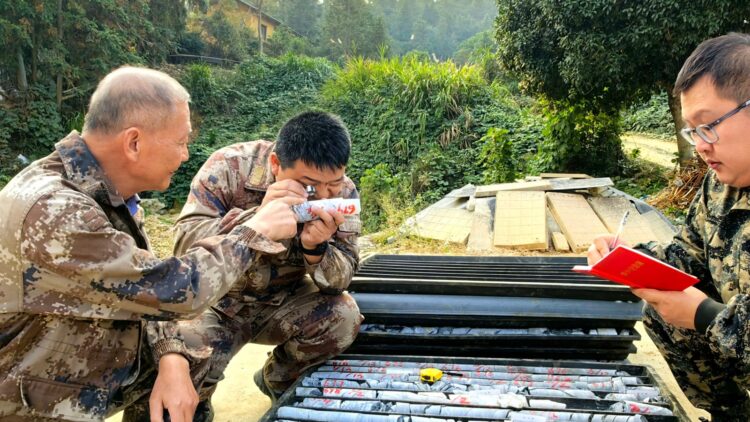
Chinese geologists discovered a buried system under the Wangu gold deposit in Pingjiang County (Hunan Province), that could have more than 1,000 metric tons of gold in it; 300 tons have already been detected.
The estimated value is around 600 billion yuan (or about $85,215,780,000.00), and if it’s confirmed, it might be one of the biggest gold discoveries ever reported, although, it has not yet been confirmed, according to ScienceAlert.
It’s an impressive discovery and a huge amount of money, but it’s not really “money in the bank,” as people say, or at least, not yet.
More holes have to be drilled to verify that information, and initial projections could change.
What the research team found
According to the Geological Bureau of Hunan, geologists found over 40 gold-bearing veins at a depth of roughly 2,000 meters using 3D modeling to predict mineralization to a depth of about 3,000 meters.
According to Chen Rulin, a prospecting expert: “Many drilled rock cores showed visible gold,” in one interval, along with a maximum sample grade of about 138 g/t.
“Visible gold” indicates a fertile system, but a high-grade interval does not really define the average grade of the entire body. For a mine, you still need continuity, thickness, and repetition of better zones over long distances.
The Wangu gold deposit
The Jiangnan Orogen, where the Wangu field is situated, was formed by fractures and collisions that created hot fluid pathways.
According to Peer-reviewed research, northeastern Hunan is Jiangnan’s largest yellow metal region, with resources over 315 tons (before the announcement).
It takes time, a lot of drilling, and tests that show mineable connectivity in a reliable manner to transform a modeled resource into a proven reserve. However, since China right now produces about 10% of the world’s gold, any developments at all, related to this discovery could impact global supply chains.
Even though the immediate effects are still small, analysts like Chen Wei predict that long-term considerations are going to boost the market impact.
“Visible gold” doesn’t always mean a viable mine
In order to move air and cool working areas, deep mines have to cope with hotter rock, complicated ventilation, higher pressures, and more energy—between 40% and 80% of a mine’s energy consumption is because of ventilation.
How will the yellow metal be extracted, and how much will it cost the environment, if it is real and mineable? Advanced groundwater management and chemical mitigation techniques are going to be necessary for deep mining operations, and mining-related global emissions could exceed 100 million tons of CO2 per year.
Chinese mining officials are taking into account methods like paste backfill and water filtration to guarantee sustainable extraction practices and reduce the impact on the planet.
A lot of people talk about a “green side” to gold, but it’s more complicated than that. Although phones and other electronics require gold, we don’t “have to” get it from the ground. For this reason—while China hopes to find more gold—the UK’s Royal Mint is recovering gold from outdated devices instead of excavating it.
Finding balance between economic potential and environmental impact
Progress does not always equate to more metal. Nowadays, a mine is evaluated not only on the amount of gold it produces but also on the amount of land it has to be disturbed to get it out, the amount of water and energy it uses, and the amount of pollution it produces.
Planning a mine and getting permits could get easier if scientists conduct additional drilling and the gold shows up in thick, and connected layers.
However, if it only appears in tiny “pockets” that are divided by poor zones, Then it might only be worthwhile to only extract the richest areas—or not mine at all.