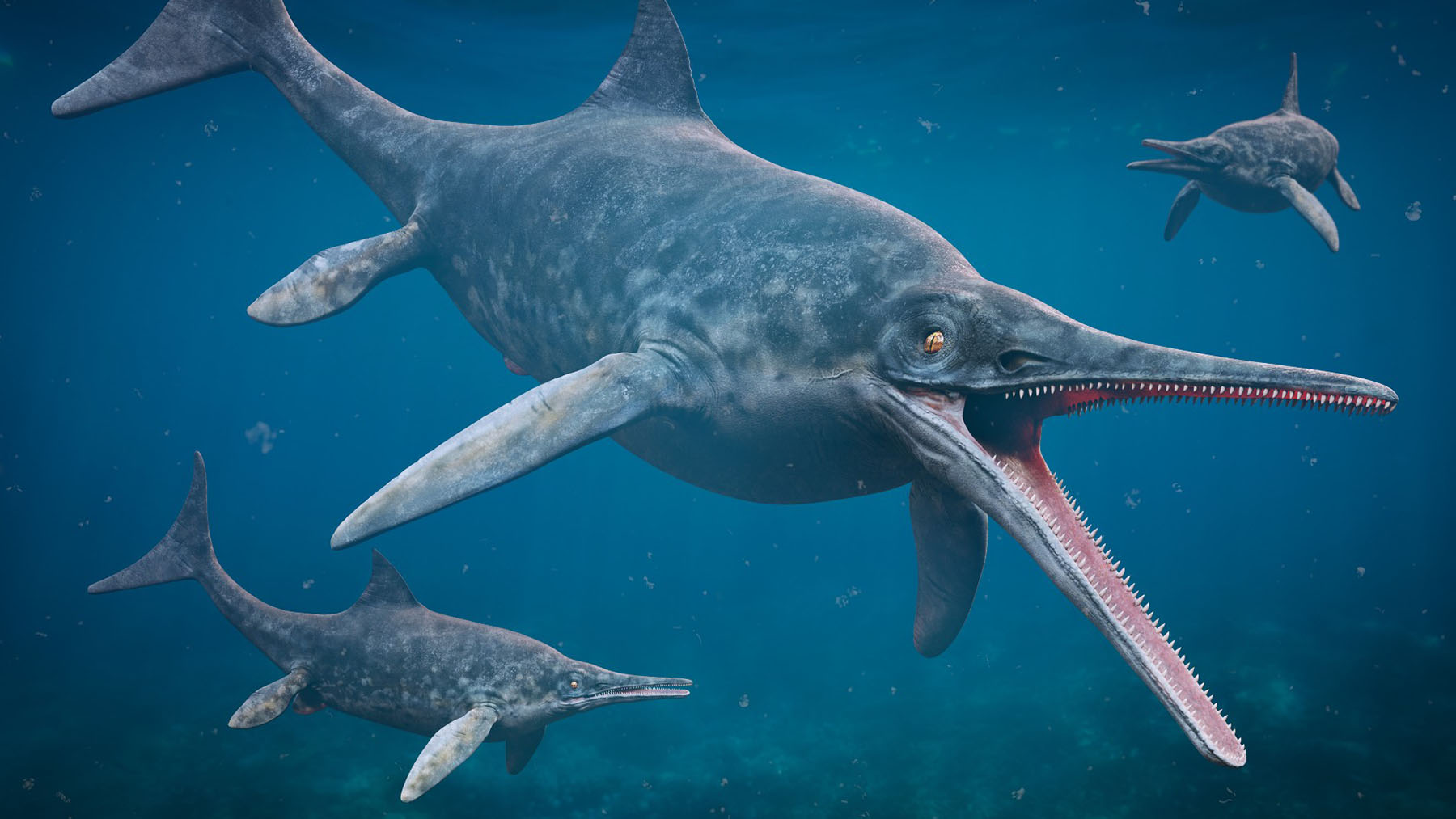
Scientists discovered a prehistoric “sea monster” that may have been as large as modern blue whales. relaxing walk along the English coast.
In May 2020, Ruby Reynolds, an 11-year-old “fossil hunter,” was walking along the English coast and exploring the muddy beaches of Blue Anchor on the west coast while she found pieces of a massive lower jaw.
Ichthyotitan severnensis, also known as the “giant fish lizard of the Severn,” is a new genus and species of giant ichthyosaur that was officially named after a bone and a similar fragment discovered nearby in 2016. With careful measurement, the research team calculates a total length of about 25 meters (range 20–26 meters).
This species would be the largest marine reptile officially described to date if those figures are verified with additional fossils.
A two-meter jaw built from fragments
A curved section of the lower jaw that, if complete, would have measured more than two meters is the best-preserved section. That is what first captured scientists’ attention.
While the research shows the limitations of working with incomplete remains, Dean Lomax described the discovery to Reuters as “very exciting.”
After several visits, the team was able to reconstruct almost two thirds of the giant jaw element from the Blue Anchor specimen, which had appeared in multiple pieces. Some of these had been left on a rock by an unidentified person and others had been discovered on the nearby shoreline.
The match with the Lilstock specimen, (discovered in the same geological unit: Westbury Mudstone Formation) approximately ten kilometers away, is very interesting. Because of their unusual shape and internal characteristics, the researchers believe that both bones belong to the same new species.
The formal description was published in PLOS ONE on April 17, 2024, and on January 16, 2025, the journal published a correction.
A giant that was still growing at the time of death
The study looked at the fossil’s size and also its microstructure and found very interesting histological traits that have been documented in other massive ichthyosaurs.
The outer part of the bone shows signals consistent with active growth at the time of death.
The authors think that prolonged growth strategies happened to get such large final sizes because the animal was still growing. That idea is fascinating. However, since there’s not enough information yet, all estimates have to remain provisional.
Ichthyotitan severnensis lived approximately 202 million years ago during the late Triassic (Rhaetian age), when shallow seas covered portions of the modern United Kingdom.
Just above the fossil-bearing layer, there is evidence of a mass extinction that changed marine and terrestrial life near the Triassic–Jurassic boundary. The authors speculate that this lineage of giants probably disappeared during that end-Triassic crisis and that ichthyosaurs never again reached such enormous sizes.
Unexpected discoveries becoming scientific proof
This case is still an example of how fragments can rewrite the past of marine reptiles. In future years, extra fossils could improve the measurements and validate (or completely change) Ichthyotitan’s status as the largest marine reptile ever recorded.
If you compare it to other ichthyosaurs that did not repeat that gigantism after the end of the Triassic, it could be competing with the blue whale. But to confirm that information, potential records, solid theories, and discoveries will have to complete the circle.
This piece of evidence was taken from the beach to the scientists because the people who discovered it reported it and the community of collectors and researchers came back over and over again to find additional data.
You never know what the sea can bring to you. If you find something odd, just like Ruby did, get in touch with the experts.