
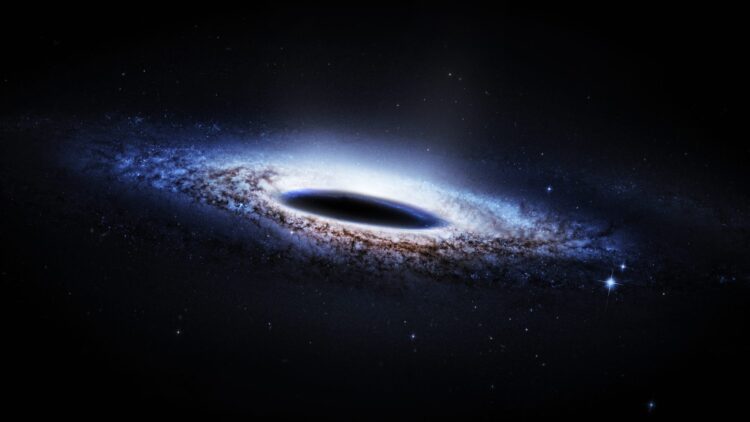
We have all been entranced by the concept of black holes, after all it is not every day that we hear about an experience that is able to obliterate an entire system without leaving any trace behind. But NASA has discovered that not every black hole was created the same and they not all have the same size, and so the impact that they have on the celestial bodies surrounding them is not the same. Lately NASA was able to detect, in a galaxy quite far from ours, a black hole that did something unexpected, and just swallowed a star.
The fun thing about black holes is that they are invisible. They are regions in space with gravity so strong, not even light can get away. It has been described as a cosmic vacuum cleaner that absorbs everything in its path, and because light cannot escape from it they are virtually impossible to detect and are better seen by the absence of what is there than by what there is.
There are also very few telescopes that can detect them, but NASA has a few of their most powerful ones trained to detect them. The Zwicky Transient Facility scans the night sky for new flashes and explosions and then the Hubble Space Telescope takes incredibly sharp images from its orbit high above helped by the James Webb Space Telescope which can see types of light that others cannot.
The new black hole that NASA is studying
While there are many, many black holes in the universe, very few are that we have seen that are as big as this one. The ones that are this size have the mass of millions of suns and usually inhabit the centers of galaxies, but this one was found on the edge of it, making it even more special to study.
They had very little time (comparatively) to figure out this black hole, as scientists just noticed an incredibly bright blast of ultraviolet light which they discovered after was coming from a star being torn to shreds. This event has a name, Tidal Disruption Event, or TDE and is applied to instances where the black hole’s gravity grabs hold of a star and pulls it apart. It is a fairly violent process, and it lets off so much energy that telescopes here on Earth can pick it up.
But the fascinating part of this seems to be where the hole was located, as it is really very strange and not at all in line with what we know from the universe. There are some theories but the most accepted one seems to be that this was the result of a galaxy collision. Since all celestial bodies in space are in constant movement, two galaxies may have collided with one another and their central black holes may have ended up displaced, with one in the middle and the other one in the edge of the new formation.
Another theory is that there could have been at some point three or more black holes close enough together to affect their gravitational forces, as when three or more get too close, these compete and can end up forcing one another out of the way. The force of this collision would then move the hole far from where it started and have it roam the galaxy until a star crosses its path.
The good thing about this is that it gives scientists something more to study, as these events are rare and even more rarely caught on camera for them to study. Given how hard they are to see because of their nature, scientists take every possible opportunity to learn as much as possible about black holes, even if the information is not as standard as we would like.