
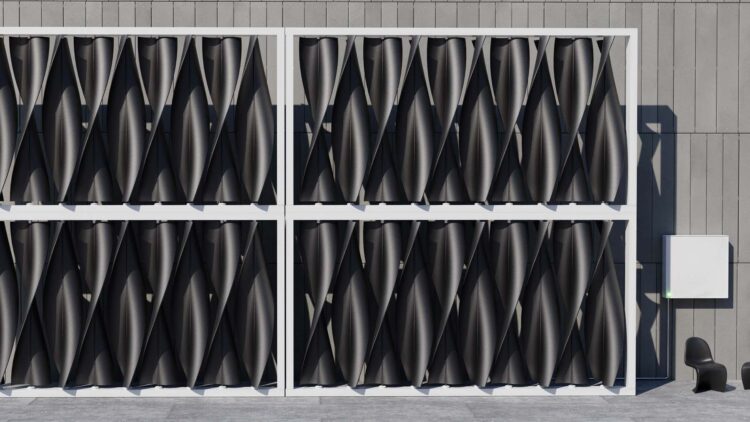
The concept behind Joe Doucet’s Wind Turbine Wall is a silent black wall that produces electricity in your backyard. Doucet suggests a sleek wall of tiny vertical turbines to capture wind energy in urban areas instead of a standard solar panel on the roof.
The system’s compact design, is made for neighborhoods with strict design regulations, mixing sustainability, functionality, and aesthetics. The target is to provide up to 10 kW of power and around 10,000 kWh annually, which will be enough for part of the energy a house needs. Doucet’s project, combines sustainable architecture and industrial design, advancing the idea of clean energy and decentralized energy for cities that are highly populated, like Tokyo, London, and New York, where standard turbines are usually rejected,
In windy and cloudy conditions, the goal is to help rather than replace the solar panel. This technological innovation provides yet another creative strategy for the future of renewable energy in a world where climate change is continuously affecting people.
How does the Wind Turbine Wall work?
Installed on an eight-foot-tall wall, the Wind Turbine Wall is a modular vertical wind turbine system that integrates 25 small vertical-axis turbines. Each one can generate 400W, which adds up to nearly 10 kW, or 10,000 kilowatt-hours of power per year, depending on the wind.
Why is it vertical? These turbines can capture air from various directions while rotating on their own axis, and this makes them ideal for urban areas where buildings cause wind patterns to changes a lot. In contrast to a solar panel, which is dependent on daylight, the end result is a silent, stylish installation that generates energy continuously.
The wall can be independent, integrated with home battery systems, or connected to the power grid. It can even be installed next to highways as a substitute for standard noise barriers, turning empty walls into clean energy sources. The concept of decentralized energy is well suited to this design since it produces electricity near to where it is used, lowers transmission losses, and increases community autonomy.
There are still certain obstacles to get past
Space is limited in crowded cities like New York, London, or Tokyo, and big turbines are very difficult to integrate into the urban environment. An attractive solution is a vertical wind turbine disguised as a wall; it adds to renewable energy without disturbing the neighborhood, looks contemporary, and produces little noise.
For homes with small rooftops or in regions where wind and clouds are common, combining wind energy with solar panel systems can be a great solution for energy production throughout the year. While solar power works best on sunny days, the wall works best on windy ones.
But there are difficulties. Joe Doucet is looking for production partners to scale the design because manufacturing costs are still high. Location has a major impact on efficiency; the amount and direction of wind in each area will determine how much energy the wall generates. Additionally, there is a difference between lab results and actual performance; in practice, output may be less than hoped for.
Useful design for a changing world
The logic behind the system is still strong, though, as several tiny rotors reduce noise, lower vibration, and blend in with the city. Furthermore, the design gives households more options for how to approach sustainability and energy independence because it gets the best of both worlds.
Doucet has the potential to become a new symbol of clean energy and decentralized energy for big cities if it finds the right partners and the wall works well in everyday situations. The Wind Turbine Wall shows that the architecture where we live does not have to hide the future of domestic energy anymore.