Heat can be unbearable in summer, and it just keeps getting worse every year in Europe. Having this in mind, two students from the Zurich University of the Arts (Switzerland), designed a brick that cools your house.
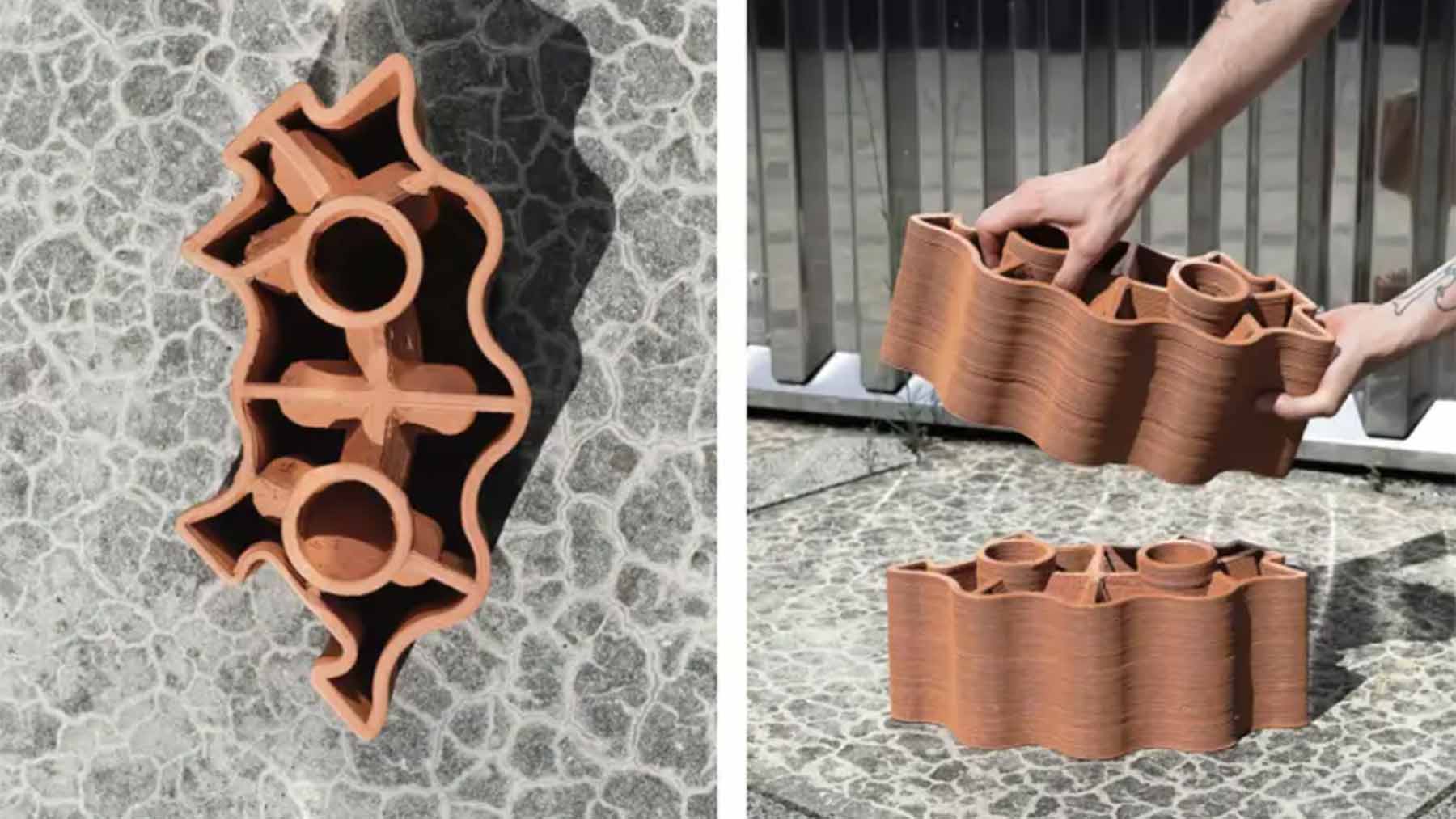
To help to combat extreme heat, “Bloc°,” a modular terracotta brick, can reduce temperatures in unshaded areas by up to 9 °C. It uses solar energy and terracotta for evaporative cooling.
This invention by Andrin Stocker and Luc Schweizer made it to the James Dyson Award finals.
Using old cooling tricks to help cities stay cooler today
The students explain that, “Bloc° is inspired by traditional knowledge, natural systems, and urban objects” and was created to “it addresses the growing problem of urban heat islands and makes cities more livable during extreme heat events.”
The students used passive cooling techniques, like terracotta jars, termite mounds, and badgir—wind catchers—that can control airflow and temperature.
How cities could become cooler with just a brick
Bloc° is a brick that uses solar energy and terracotta for evaporative refrigeration to cool hot urban areas.
This low-tech modular cooling system naturally reduces temperatures by up to 9 °C using water, air, and sunlight. Its porous blocks, which are made of 3D-printed terracotta, absorb water that evaporates as hot air moves through the system using solar-powered fans.
It uses about 50 liters of water per day above 30 °C, which can be collected through rainwater harvesting or the network.
The solar panel produces about 200 Wh, which is enough for the pump and fan to run on its own. According to its designers, it is “scalable, mobile, and energy-efficient” and “ideal for use in public spaces such as transit stops, plazas, or schoolyards.”
“We combined digital and physical experimentation to refine both form and function. Using VR headsets, we worked extensively in a 1:1 scale digital environment, allowing us to understand spatial proportions and how bloc° would perform in real urban contexts.” They explained.
In addition, inspired by the self-shading geometry of cacti, they “adapted the form of the prototypes to reduce direct sun exposure and optimize cooling efficiency”.
After material testing, single-fired terracotta was selected because of its “remaining porous enough for effective evaporative cooling while still being structurally stable.” The final product was a system that could “address the climate crisis while respecting urban needs.” And it proved that it was effective, visually attractive and inclusive.
From prototype to practical testing
There are already similar bricks, but, Bloc° offers some good advantages. Because according to Stocker and Schweizer, it’s “unique not only because it combines traditional passive cooling with modern design but also due to its innovative water storage capacity within each individual brick.”
This allows it to expand freely in both height and width and is actually modular.
Even in regions with higher humidity levels, like Central Europe, it improves evaporation and cooling with solar-powered fans and pumps.
A simpler, greener way to stay cool during heat waves
For Stocker and Schweizer it’s very clear: “We aim to scale up Bloc° as a sustainable cooling solution for diverse environments worldwide.” They told the James Dyson Award.
It could reduce the dependency on air conditioning in public areas, because they would save energy—which would also mean lower electricity bills—and still keep you cool enough during heat waves.
However, to evaluate long-term performance (especially in humid climates), and develop the design for better cooling efficiency, full-scale field testing needs to be done next.
Furthermore, they are investigating possibilities for large interiors or as a façade element. This will define how well it performs in different climates and make installation less complicated.