
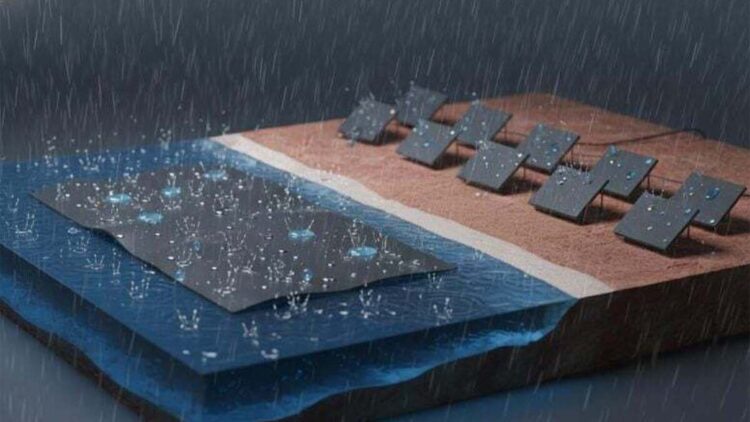
Raindrops can give us a lot more that a reason to use un umbrella: Scientist in China are exploring new ways to create energy. And for now, using water coming from the rain is the most innovating one.
Researcher in China have discovered that raindrops are full of energy that can be used to feed electric generators
Hydraulic energy in this form has been going on for a while already, but it seemed to have more “downs” than “ups”: lower efficiency and not much capacity to improve. However, the new invention of a floating electric generator for raindrops, developed by the Nanking University of Aeronautics and Astronautics uses water as the essential part of its structure.
The difference between this new model and the older ones is that this raindrop method operates directly over water and reduces costs. It’s also lighter and more responsible of the environment because we are talking about a more practical renewable energy
How does the system work?
When the rain falls on the surface of the dielectric, it absorbs the impact because of the superficial tension, and the fact that it doesn’t really understand the water. Then, the ions from the water act like if they were electrodes (because of its charge). The device can generate a voltage of about 250 per raindrop, which is similar to older models.
In other generators, the electricity happens when the drops hit dielectric films on a rigid base with a metal electrode; whit that impact, hundreds of volts are created and although it works, as mentioned before; the problem is that it’s a very expensive system.
With the new generator though, water works as a base and also as the conduction part. It’s not as heavy as the conventional one—about 80% of its weight. It floats and it cost around 50% less of what older models do.
Durability is also a great point, because comparing to previous models, this one can operate under really difficult conditions like extreme temperatures or different salt concentrations in the water. Art has been tested for it, and even with really bad storms, it keeps floating and working to generate energy.
Energy solutions asking to “make it rain”
The future of this device lies on the possibility to grow.
In the trials, they used an integrated module with 0,3 square meters, and it managed to lighten up to 50 light-emitting diodes at the same time. It also showed that it can charge capacitors for a few minutes and power small electronics and sensors.
Those are great news, yes. But it seems to be only the start; this technique could be expanded to lakes and coastal zones that have it more difficult to produce renewable energy like solar, or hydrovoltaic.
It’s a big step, another tool that it could be use to complement the other types of renewable power that already exist.
More hydro-solutions continue to be developed around the world
China hasn’t stop to work hard in the green energy race, competing for the first place, however, when it comes to water solutions, other countries continue to look for others way to find solutions to reduce fossil fuelled power.
In the Columbia River in the northwest of the United States, the Grand Coulee Dam continues to be an engineering landmark and a huge source of power.
A Canada-based company developed a small river turbine, called hydrokinetic, that can generate electricity at home, day and night, without smoke or loud noises, just from a river that flows.
Systems under the sea, in lakes, or at home are being created every year, adding up to the cause an looking for solutions that can help the planet, while still covering people’s need.