
One of my favorite things to do as a child was to abandon food containers in my school bag, even though my mother never laughed about it. In reality though, this is very common (even once we are adults), we forget food in Tupperware or leave the thermos with water in it for a long time.
Both scenarios present an actual danger, making easy the growth of bacteria and fungus that can cause food poisoning and other illnesses, regardless of the fact that they could seem like “small mistakes.”
Disinfecting these items is not difficult, but there are a few necessary steps that need to be followed if you want to be sure that it’s completely safe.
Montse Melázez, a food engineer, walks us through the details on how to remove fungus from the containers and prevent cross-contamination in the kitchen.
What to do if this happens?
The first step is to get rid of any food leftovers that have gone bad, especially if they have mold on them. The best way is to throw them away in a different bag to avoid that the infection spreads to the other trash or the collectors get sick when they are handling it.
Next, just give the container a quick water rinse: But, to prevent contaminating other kitchen equipment, do this first wash away from them.
After removing the remnants and rinsing the container. Melázez explains that you need to make a chlorine disinfectant solution—10 drops for every liter of water.
After adding this solution to the Tupperware or thermos, let it work for about 15 minutes. If you want to guarantee a full disinfection, this time is necessary. After that, rinse well and wash as normal.
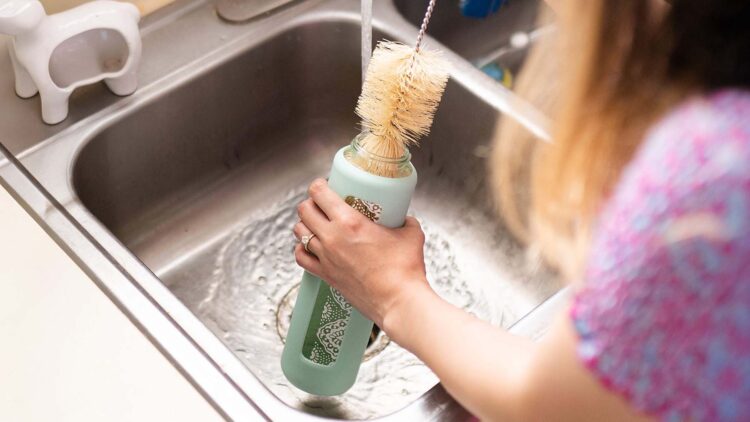
The expert suggests using special brushes to clean the interior of thermoses. “It’s not enough to pour in soap and shake; you really need to scrub to make sure there’s no film or residue left,” she says.
The last but most important step is to let it drain completely. Before putting the lid on and storing the thermos or Tupperware, it has to be totally dry because any remaining moisture can encourage again the spread of germs.
Other experts agree
One important thing to remember that a thermos or Tupperware that are still wet and has organic residues can develop a biofilm. This is an invisible layer where bacteria and fungi adhere to surfaces and protect themselves, making it hard to remove them with a superficial wash.
According to the NLM, many researches on reusable containers and water bottles has shown that they can quickly develop high levels of bacteria if they are not cleaned correctly or if they are kept closed while they are still wet.
Furthermore, because silicone seals, lids, pipes, and threads retain moisture and dirt, these parts are typically the most important to clean. Experts suggest removing every potential parts, cleaning each one separately, and letting it dry entirely.
The risk of infection and bad odors is easily reduced just by washing these containers after each use and keeping them open until they are totally dry.
How to avoid bad odors and bacteria to grow
You can reduce unnecessary dangers in your house, preserve the life of your items, and protect your health by regularly following the hygiene practices recommended by professionals.
Some tips I can give you as a very forgetful person:
- Set alarms for the time you usually get back home to remind you to empty and wash your Tupperware.
- Keep a water bottle brush next to the sink (and visible), so when you go to wash it, you can do it properly every time.
- Try to be consistent for at least 3 weeks, repetition makes it a habit.