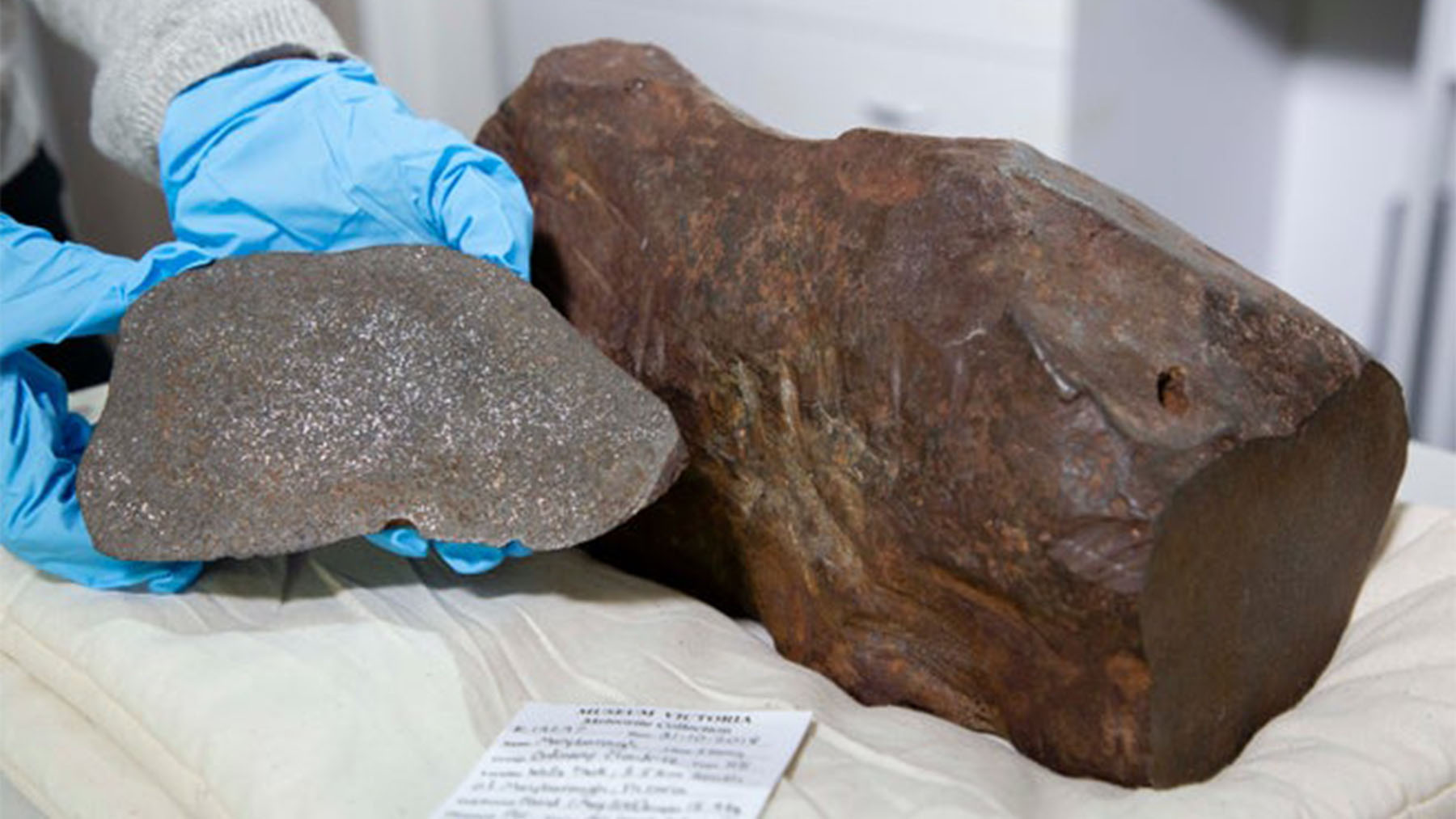
A man discovered a reddish rock buried in yellow clay in Maryborough RegionalPark—close to Melbourne—in 2015. But even more surprising than that, the rock turned out to be a 4.6 billion-year-old meteorite made of iron and nickel.
He took it home because he thought it had gold on it, and he spent years trying in vain to open it. After examination, the rock ended up being far more valuable than a nugget scientifically speaking.
The rock’s extraterrestrial origin
What at first seemed to be a common rock was actually a space visitor. Experts clarified that the way it looked gave obvious hints. “It had a sculpted, dimpled appearance.” “That’s what happens when they pass through the atmosphere; they’re melting on the outside and the atmosphere is sculpting them.” Dermot Henry told The Sydney Morning Herald.
Bill Birch, a geologist, added: “If you saw a rock like this on Earth and picked it up, it shouldn’t be that heavy.” That means that its strange weight and shape suggested an extraterrestrial origin rather than a terrestrial rock containing gold.
How scientists confirmed a 17-kilogram meteorite
The space rock was found close to Melbourne, in a place where a “heavy rock” of this kind could be identified by its density and its ability to travel through the atmosphere on its surface, according to the experts.
The man who discovered the rock, David Hole, was a hundred percent sure he had discovered a treasure and tried to open it “by any means.” After trying hard without success, researchers examined it and discovered that it was an iron-nickel meteorite, confirming its age and composition—and the reason why it was so hard to break.
They discovered that it was a typical H5 chondrite, the most common kind of rocky meteorite, weighing about 17 kg. In recognition of the discovery, a number of researchers published a study titled “Maryborough.”
They used a diamond saw to look at the inside and discovered tiny fragments of crystallized metal known as chondrules.
Recent meteorite discoveries found by local residents
It turns out that finding a rock from outer space is more common than one might think; several meteorites have been discovered by civilians in the past few years:
- In Indonesia, in 2020, a meteorite weighing about 2 kilograms fell near a home in Kolang and was initially valued by private collectors at up to $1.8 million, though its actual worth is up for debate.
- In 2021, Winchcombe residents in the United Kingdom found pieces of a 300-gram carbonaceous meteorite. The value of it is mainly scientific.
- A 24.5-kilogram Martian meteorite was found in Niger’s Sahara Desert in late 2023, and was auctioned for more than $5 million.
Why some rocks are more valuable than gold
This finding highlights how an ordinary thing can hide an incredible story. “Meteorites offer the cheapest form of space exploration. They transport us back in time, providing clues about the age, formation and chemical composition of our solar system (including Earth)”. Dermot Henry said in the Sydney Morning Herald.
People discover things coming from the space from time to time, we could say that it might be normal, since we are just a tiny part of the whole solar system where strange things—matter—are constantly flying around, crushing, exploding and therefore sometimes, crumbles end up on Earth.
There are even “meteorites hunters”: people who go around the world looking for these rocks (some for money, some for science).
So if you are walking around and spot a peculiar rock, before thinking of gold: observe the weight, texture, and “sculpted” appearance. You never know when it can be your turn to find a treasure from another world.