
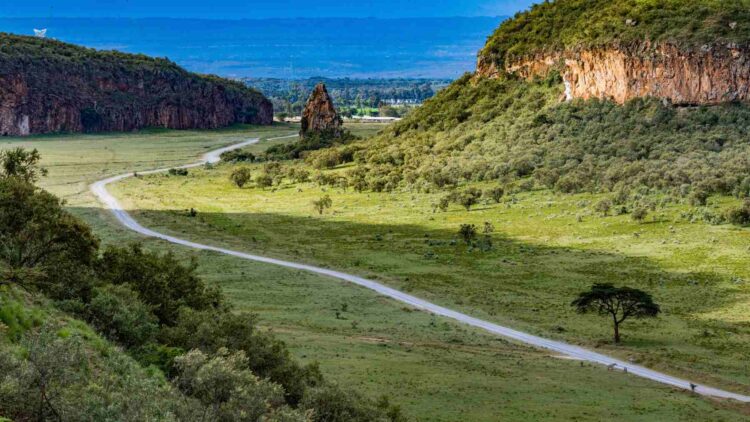
There are many areas on Earth that are dangerous, and the Great Rift Valley in Africa is a prime example of this. It is a place where two tectonic plates are separating and that makes it a prime area for earthquakes and volcanic activity. The volcanic activity is the most concerning for the area, and now a new discovery has shaken up the scientific community and residents of the neighboring areas, a massive geothermal superplume.
Superplumes are not a common occurrence in the world. Some of the most recent ones have been seen in places like Hawaii and Iceland, which areas known for their extreme volcanic activity, but finding one in Africa is a new and historic occurrence. They are gigantic, slow-moving columns of super-hot rock making its way from the core-mantle boundary all the way to the surface and quite dangerous.
The Africa superplume, a terrifying discovery
This superplume was explored in a study published in Geophysical Research Letters. It was performed as a collaboration between the University of Glasgow and Kenya’s Geothermal Development Company and it looked at gases leaking out of the Menengai geothermal field which is an active volcanic area in the middle of Kenya’s Rift Valley.
Their findings were incredibly significant, as they found that the gases were not just random emissions and that they carried a unique isotopic fingerprint, particularly from neon. When they identified this fingerprint, they found that it was identical to ones found in distant volcanoes across the Red Sea, Ethiopia, and even as far south as Malawi. What this means is that these far-apart volcanic zones are linked by the same deep-source material which is running along the African continent.
The superplume is also not contained in its space, it is now starting to reshape the land above, lifting up the earth around it. For now, it is a subtle change, but the creation of mountains and other orographic formations in the past have been linked to these superplumes and volcanic activity. In fact, the internal heat of these superplumes is what makes these regions reach higher altitude than the ground around them, creating new weather patterns, ecosystems, animal migration patterns… It could have even been the reason why evolution occurred millions of years ago.
Of course this took place over millennia, and most of the changes were so slow that they were imperceptible and so were their effects until it was too late to change. The concern that seems to be rising now is that, if this plume keeps rising and stretching the land, it is possible East Africa could eventually tear away from the rest of the continent entirely. Again this is not a process that would happen in a week or a month, these changes take thousands of years to manifest in a way that would actually make the action a danger, but there have already been signs of the process starting. Some scientists think this split could be complete within 5 to 10 million years, and a whole new ocean would be created between the two landmasses.
The signs are minuscule to those of us not in the scientific community, but those in charge of studying these types of developments have already noticed that in places like the Afar Depression, the crust has thinned drastically and is down to just a few kilometers.
Considering how long this process will take, not everything is as dire as it sounds and it might even have some short to medium term benefits. Menengai is a rich source of geothermal energy, and considering Kenya already gets a large chunk of its electricity from geothermal sources, and understanding how these systems work at their deepest levels could lead to even more efficient and widespread use of clean energy.