
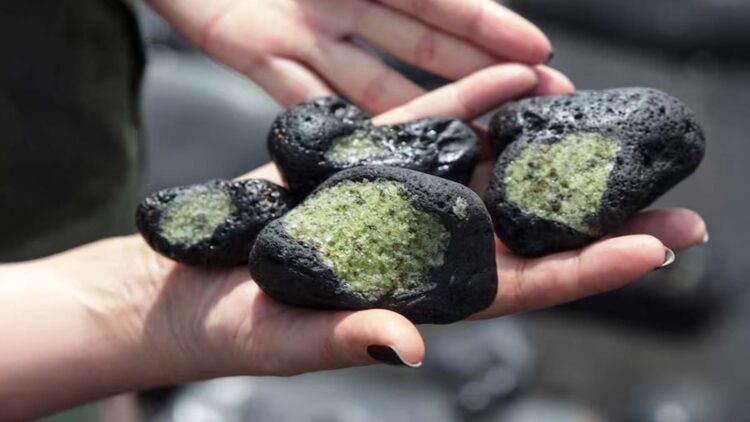
Did you know there’s a small community of people that go around the world looking for rocks coming form the space? Yes, they are meteorites hunters, and the team keeps getting bigger everyday.
For Roberto Vargas, rules are very clear: “As soon as something falls, it’s time to get moving.” His curiosity became a vocation when he did it the first time: “For some reason, I thought a normal person couldn’t own meteorites, so as soon as I had one in my hands, I got really excited.”
In 2019 he traveled to Costa Rica after the news of a recent fall. “I didn’t find it, but I was able to buy quite a few,” he remembered. “On that first trip to Costa Rica, I returned on a Friday and by Monday I had sold meteorites and made more than US$40,000, so it was a life-changing experience.” He continued. Not too long after that, he quit his job in mental health to dedicate full time to find meteorites.
From curiosity to an expanding market
Darryl Pitt—a photographer who arrived by chance—connects the findings and the collectors: “I was at the Newport Folk Festival and someone said: ‘Let’s go to a rock show.’ I didn’t know it was literally a show of stones, gems, and minerals.” He bought a fragment of the famous Arizona crater—“the same place I went as a child”—and that was enough for him to want to share that fascination and build a solid and serious market. “I realized the important thing was to introduce them into the world of auctions.” He added. In the 1990s he organized the first meteorite auction and, since then, prices rose at the same time as the number of collectors grew.
But what are they buying exactly? According to professor Sarah Russell, from the Natural History Museum in London, “A meteorite is a rock that has landed on the Earth’s surface.” Before touching land—when they cross the atmosphere like “bright fireballs”—they are meteors. “A meteorite (…) can come from anywhere. We think most come from asteroids, but some are from the Moon, some from Mars and others have an origin we don’t know.” She explained.
A key clue to distinguish them from a common rock is: “When a meteorite passes through the atmosphere, its exterior melts and forms a thin millimetric crust called a fusion crust, which is very unique.” The expert added. Also, they are usually heavier than normal rocks and are analyzed in the laboratory to confirm their chemistry. In general, there are three types: stony, metallic and mixed (petreous-metallic).
Prices, authenticity and the legal puzzle
The price of one of this rocks depends on many things: the size, if it’s a whole piece or only a part, if it’s been hit by and artificial object, how rare its composition is, its classification and origin.
“You can acquire a meteorite for as little as 20 or 30 cents per gram,” says Pitt, Although he warns about fakes on online platforms. Extraordinary specimens, like a 24-kilo Martian meteorite was sold for US$4.3 million in New York.
The Martian case of Niger (November 2023) and its auction turned on huge alerts. “Normally, objects like that… must be accompanied by an administrative authorization… Otherwise, it is theft or looting,” said the professor Idi Umuru Amadou. Rules change everywhere—“For example, in Australia export is not allowed… while in the United Kingdom there are no specific laws”—and create confusion.
Laws and fair access to science
For Vargas, the key is responsibility: “Yes, we have economic motivation, but also scientific…”
Not everything is about making money. Teams like the “Azmeteóricas” in Latin America, find rocks to take them to laboratories and museums. They asks for clear rules, but still allow anyone to look for it, because “If it is prohibited, we will have fewer to study… That’s why we need a law.” Amanda Tosi, meteorologist, stated.