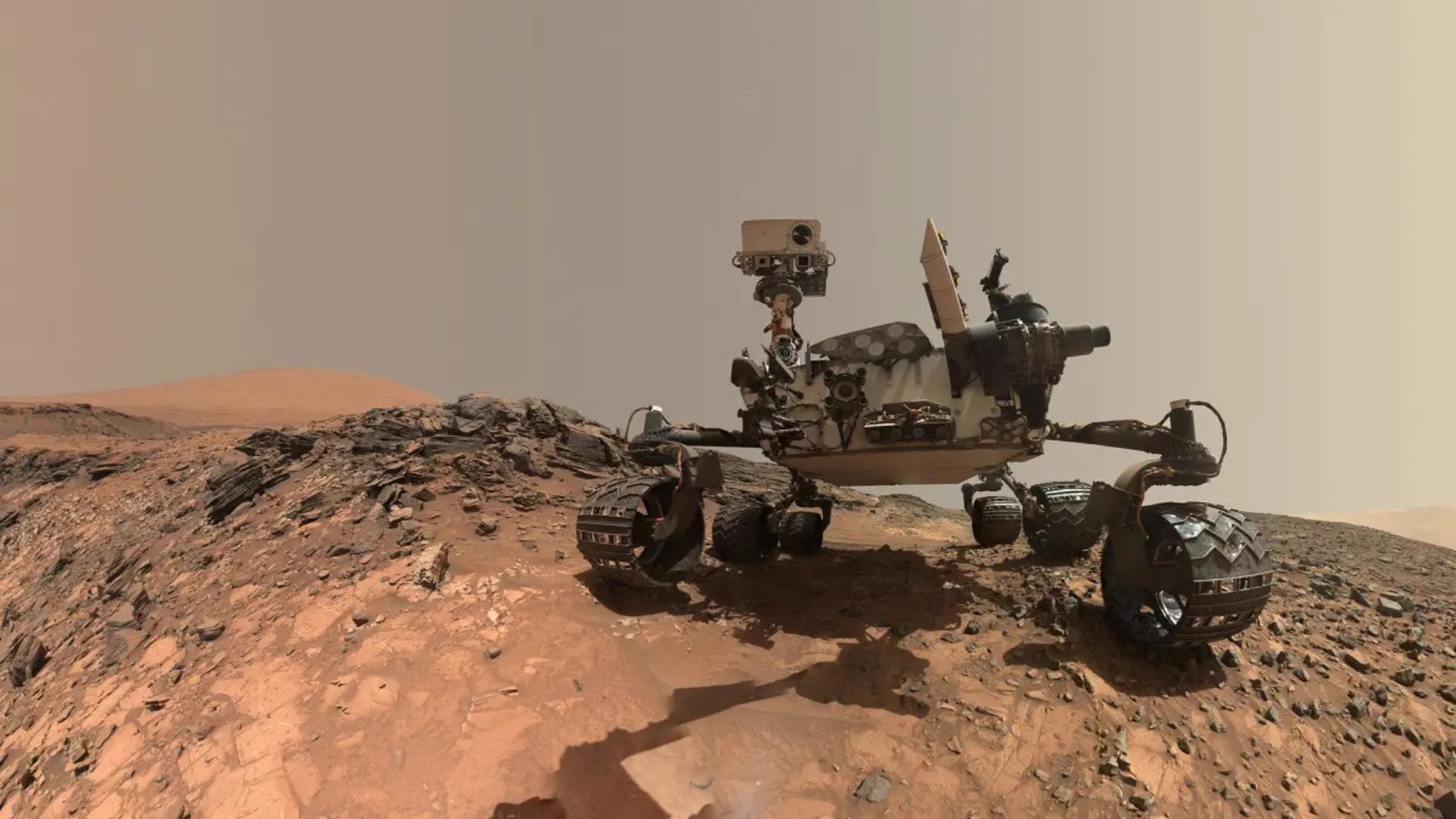
On May 30, 2024, NASA’s Curiosity rover unintentionally made a discovery while exploring the Gediz Vallis channel on Mount Sharp. When it accidentally fractured a rock with its weight, the robot exposed crystals of elemental sulfur, a substance that had never before been recorded in its pure state on Mars.
Unlike common sulfates derived from evaporating water, this “native” sulfur requires specific conditions for its formation, which do not match the history that is currently known of that area. Scientists have described the finding as an “oasis in the desert,” and it has forced them to question the chemical processes that were believed to have been responsible for Mars’ formation, while also raising new questions about habitable environments in Gale Crater.
Unexpected discovery
Discoveries made in space do not depend solely on planning or the technology used in missions; they also rely on a bit of luck. Luck was on NASA’s Curiosity Rover’s side in May 2024 when its wheels crushed a common rock. When the rock split open, it revealed crystals of a vibrant yellow color. It was elemental sulfur, an unprecedented find that breaks with what the rover had documented for more than a decade.
Although sulfur is common on Mars, it had never been recorded in this pure form, only within sulfates (salts). The presence of pure sulfur is an anomaly that does not fit current models. The team’s astonishment grew even more when they discovered that it wasn’t just a single rock, but an entire field. Curiosity project scientist Ashwin Vasavada described it as “Finding a field of rocks made of pure sulfur is like finding an oasis in the desert”.
Gediz Vallis’s past
Another aspect that left NASA researchers puzzled was the location of this discovery. It was found in the Gediz Vallis channel, a fissure in Mount Sharp, with an elevation of 5 kilometers (3 miles) within Gale Crater. Curiosity has been climbing this mountain since 2014 and had never detected anything like it. Since October 2023, the rover has been traversing a region characterized by a high presence of sulfates, which indicates that in the past water evaporated and altered the chemistry of the environment.
However, the appearance of sulfur in its purest state suggests that the past of Gediz Vallis was more violent than previously thought. Scientists, including Becky Williams from the Planetary Science Institute, suspect that the channel was carved by flows of liquid water and debris. After analyzing the piles of sediments caused by floods and landslides, Williams concluded decisively: “This was not a quiet period on Mars”.
Confusion at NASA
On Earth, native sulfur is usually linked to volcanic processes or hot springs, environments where heat, water, and rock interact in extreme ways. However, NASA has been cautious, noting in its updates at the end of 2024 that “there is no evidence on Mount Sharp” pointing to volcanoes or geysers in that specific area.
This lack of evidence is what captures scientists’ attention. Pure sulfur can arise through various chemical pathways, each requiring different environmental conditions. What is clear is that its presence reshapes the map of ancient chemical environments on Mars and, although finding sulfur is not equivalent to finding life, it does define the conditions necessary for microbes to have, theoretically, survived.
What’s next?
After completing its analysis in Gediz Vallis in 2024, the Curiosity Rover’s new destination is the region known as ‘boxwork,’ a pattern of mineral ridges formed underground. According to Kirsten Siebach, a Curiosity scientist, she explained the appeal of this new stop: “These ridges will include minerals that crystallized underground, where it would have been warmer, with salty liquid water flowing through them”.
Frequently asked questions
Why is the discovery on May 30, 2024, historic?
Because the Curiosity rover discovered pure (native) sulfur by accidentally breaking a rock. It is the first time this material has been confirmed on Mars in its pure state, as previously it had only been found mixed with salts.
What does this mineral reveal about the Gediz Vallis channel?
It suggests a much more violent past. The discovery of pure sulfur in an area without visible volcanoes challenges current models. As Becky Williams noted, floods and avalanches show that “this was not a quiet period on Mars”.
Where is the rover heading now?
Curiosity is moving to the “boxwork” region, an area with mineral ridges formed underground. Scientists aim to study these ancient environments of warm, salty water to understand whether Mars could have been habitable for microbes.