
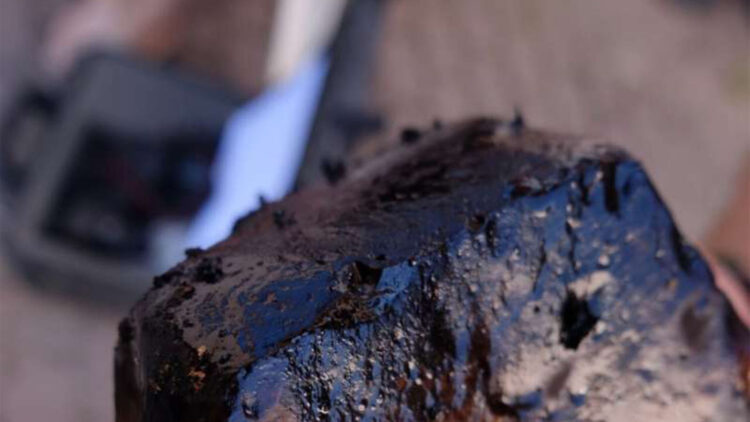
A new discovery is changing the path of history: a chewed nodule for birch tar has been found in the Neolithic settlements in the Alps and have preserved traces of human DNA, yes, ancient one, and with it, pieces of oral microbiome from those whom used it 6,000 years ago. The study, published in Proceedings of the Royal Society B, shows how this material that was used as prehistoric adhesive to glue stone tools and fix ceramic, also worked as a biological time capsule that retained signs form early agriculture and Neolithic cultures.
Putting the focus on molecular archaeology, the researchers analysed pieces that came from Alpine lake villages, where humidity and the mack of oxygen made the conservation possible.
What’s really impressive is that because the birch tar was chewed before being used, it trapped saliva on it and with it, genetical profiles and microbiomes that very rarely survive in the kind of situations.
A sticky technology with human prints
The birch tar was produced through controlled distillation of the cortex in the absences of oxygen. It was waterproof, durable and versatile. It could adhere to ceramic and stone tools, and sometimes it would be found by itself with teeth mark on it, which is why scientists believe it was chewed to make it maleable of it’s use.
The team studied 30 pieces from 9 different Neolithic settlements in the Alpine region, many which where next to the lakes. And in this anoxic environment, the organic material is preserved exceptionally, and the birch is in time a unique biological reservoir. Through chromatography and sequencing of ancient DNA, scientists were able to find the composition of the glue, and some signs of the human DNA for those who touched it.
There was traces of both men and women, and in some cases even multiple people in only one piece, which suggest that it was either shared to use or some sort of social transmission or technical knowledge.
The oral microbiome analyses revealed that birch tar can preserve DNA better that fossilised teeth, besides, it give us information about health and oral habits at the time. But also, at the same settlement they found the remains compatibles with plants and animals, who also fit in the early agriculture and hunting from that time.
Shared work, learning and daily life
The genetic patterns what were found and put together, allow scientists to understand more about work and learning scenes at the time. Some of the pieces were associated with fixing ceramics, and they had mostly female DNA on it, while fragments that were linked to hunting, had male signals. The sample’s informations is still very limited to have a true and definitive answer, but for the moment it suggest a division of tasks depending on the individual’s sex, in some areas.
However, finding the remains of many individuals at the same fragment points to moments of joint manufacturing, maybe between couples or groups in shared practices that mix technique, hygiene and maybe medicinal use. This is how the molecular archaeology linked the findings to the The Alpine “lake-dwelling” communities (ca. 4300–3500 BCE).
And chewable file from the Neolithic
The study in Proceedings of the Royal Society B shows how ancient DNA can reveal sex, participation, and practice. This ancient “chewing gum” is a compact story about the Neolithic in the Alps, putting together technology, cooperation and daily life codify on a bite of birch tar.
Archeology is always surprising, at least for me, it is. This time, is giving us another lesson, a proof of how little “waste” if it’s well analyzed can give us so much information about the lost voices for the past.