
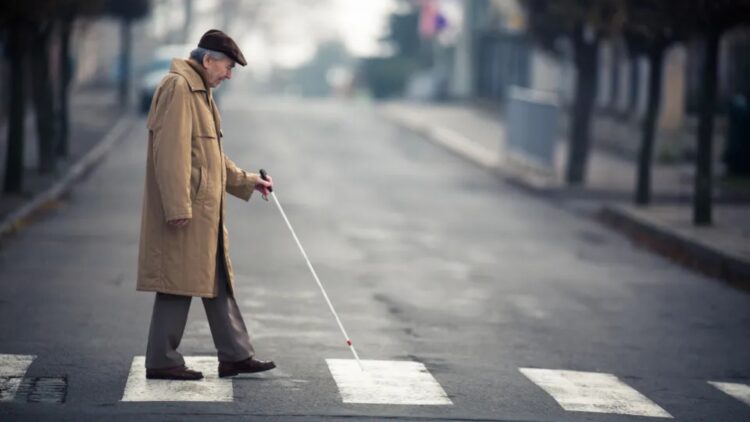
Pedestrian crossings are essential to mitigate the inherent dangers on the roads, where many reckless drivers and smaller vehicles ignore traffic safety rules. In this context, and with the aim of enhancing pedestrian safety, the North Carolina General Assembly has decided to take action and has passed Bill 275, which strengthens the protection of a particularly visible group of pedestrians: pedestrians with visual impairments. This new measure will apply at all road crossings, even without traffic signals. Drivers who fail to comply will face a Class 2 misdemeanor with minimum penalties of $500, a 90-day license suspension, and, in more serious cases, 6 days in jail and up to $1,000 in fines.
Importance of crosswalks
Roads are notoriously dangerous for pedestrians, even when they are as visible as possible. Drivers often have difficulty detecting people on foot, especially when they appear in unexpected areas. That is why crosswalks are one of the zones that drivers know they need to watch out for, as they are spaces designed for pedestrian safety.
These areas aim to concentrate pedestrian crossings in a specific zone, thus organizing traffic and the safety of both pedestrians and drivers. This reduces the randomness and unpredictability of people crossing the road at any point. Despite these rules, there are drivers who ignore regulations, not obeying crosswalk rules, such as when and where they should stop to let pedestrians pass. This safety threat affects all pedestrians, but especially those with visual impairments, who become even more vulnerable.
Bill 275, North Carolina
In this context, the North Carolina General Assembly has chosen to strengthen existing laws regarding pedestrian crossings through the approval of Bill 275. Through this bill, it specifies exactly what drivers must do when there are visually impaired pedestrians present. It will apply to any road crossing, including those without officers or traffic signals.
According to the bill, drivers must yield: “if such a blind or partially sighted pedestrian extends a white or white-and-red-tipped cane in front of them, or if such a person is accompanied by a guide dog”. If a driver encounters such a pedestrian, they must come to a complete stop and “remain stationary until the blind or partially sighted pedestrian has completed crossing that road or intersection”.
Penalties for noncompliance
So far, the pedestrian crossing law only constituted a minor infraction for drivers, but with the new bill, it has become a Class 2 misdemeanor. This means that both financial and criminal penalties are higher. The minimum penalty if a driver fails to stop completely to allow a blind or partially blind pedestrian to cross is $500 and a 90-day license suspension. More serious cases can result in a fine of up to $1,000 and 6 days in jail.
Frequently asked questions
What does the driver have to do when coming across a visually impaired pedestrian?
According to the new Bill, “Remain stationary until such blind or partially blind pedestrian has completed the passage of such crossing or intersection”.
What are the penalties for non-compliance?
It is now considered a Class 2 misdemeanor. That means that fines can be between $500 and $1,000, 90 day licenses suspension or even 6 days in jail.