
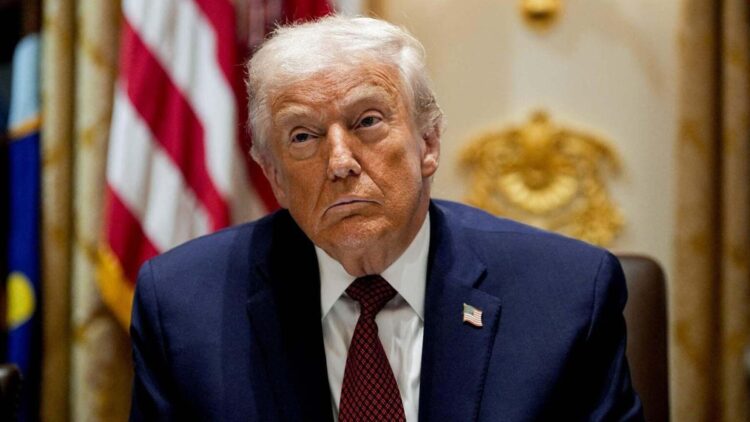
President Donald Trump has reached a new deal with China, and this time, it is not about Tiktok. Nvidia, an American chip manufacturer will be authorized to sell the H200, one of its most advanced chips—and fundamental part for artificial intelligence (AI).
While trying to protect national security concerns, Joe Biden had done the exact opposite when Washington limited these chips. The announcement is already creating strong reactions in the United States, with some describing it as a wise economic move and others pointing out that it might strengthen China’s military and technological powers.
What exactly did Trump announce?
Nvidia’s H200 is a very potent chip used to train and operate AI systems, and because U.S. officials were concerned that this chip and similar high-end models could potentially be used for military or for strategic purposes, they were banned from being exported to China under the Biden-era regulations.
Trump now says that Washington would permit Nvidia to ship its H200 to “approved customers in China, and other Countries, under conditions that allow for continued strong National Security,” he wrote in a post on his social network Truth Social.
Additionally, Trump added that China’s leader responded favorably to this choice. He wrote: “President Xi responded positively! $25% will be paid to the United States of America.” He did not, however, clarify what that “25%” would actually entail or whether it is a tax, fee, or another kind of payment.
How does this compare to the Biden-era restrictions?
The goal for Joe Biden was to restrict China’s access to fundamental parts that could be used to develop more potent weapons, improved surveillance equipment, or other military technologies.
Nvidia was prohibited because of it from shipping the H200 and other high-end chips to China. The company had to create lower-performing, weaker versions of its products in order to get past export regulations and maintain some presence in the Chinese market. There weren’t many options even then.
A different approach is taken by Trump’s new policy. The H200 can only be sold to “authorized” customers who have been approved under U.S. conditions, as opposed to a complete ban. However, Nvidia’s most recent and potent chip families—Blackwell, and Rubin—are excluded from this.
The deal shows an export policy that still have control over delicate technologies; some sophisticated chips can be exported under supervision, while others are still strictly prohibited.
How are Nvidia and U.S. politicians reacting?
The reaction to Trump’s move is divided:
“There’s no world in which they are not going to continue to press as hard as possible to have a domestic industry that will ultimately have as its goal the bankruptcy of Nvidia and the dependence of the United States on Chinese AI,” said Stewart Baker, a former Homeland Security and National Security Agency official.
According to Senator Ron Wyden, Trump has been “taken to the cleaners by China yet again,” and “every American will be less safe because of his terrible deal on AI technology.” Representative Raja Krishnamoorthi of the United States, meanwhile, called the action a “profound national security mistake and a gift to our top strategic competitor.”
On the other hand, Nvidia welcomed the ruling. “We applaud President Trump’s decision to allow America’s chip industry to compete to support high paying jobs and manufacturing in America.” a company representative told BBC News.
All supporters claim that the nation can protect national security while still enabling American businesses to profit from China’s sizable market as long as the U.S. Department of Commerce checks the purchasers.